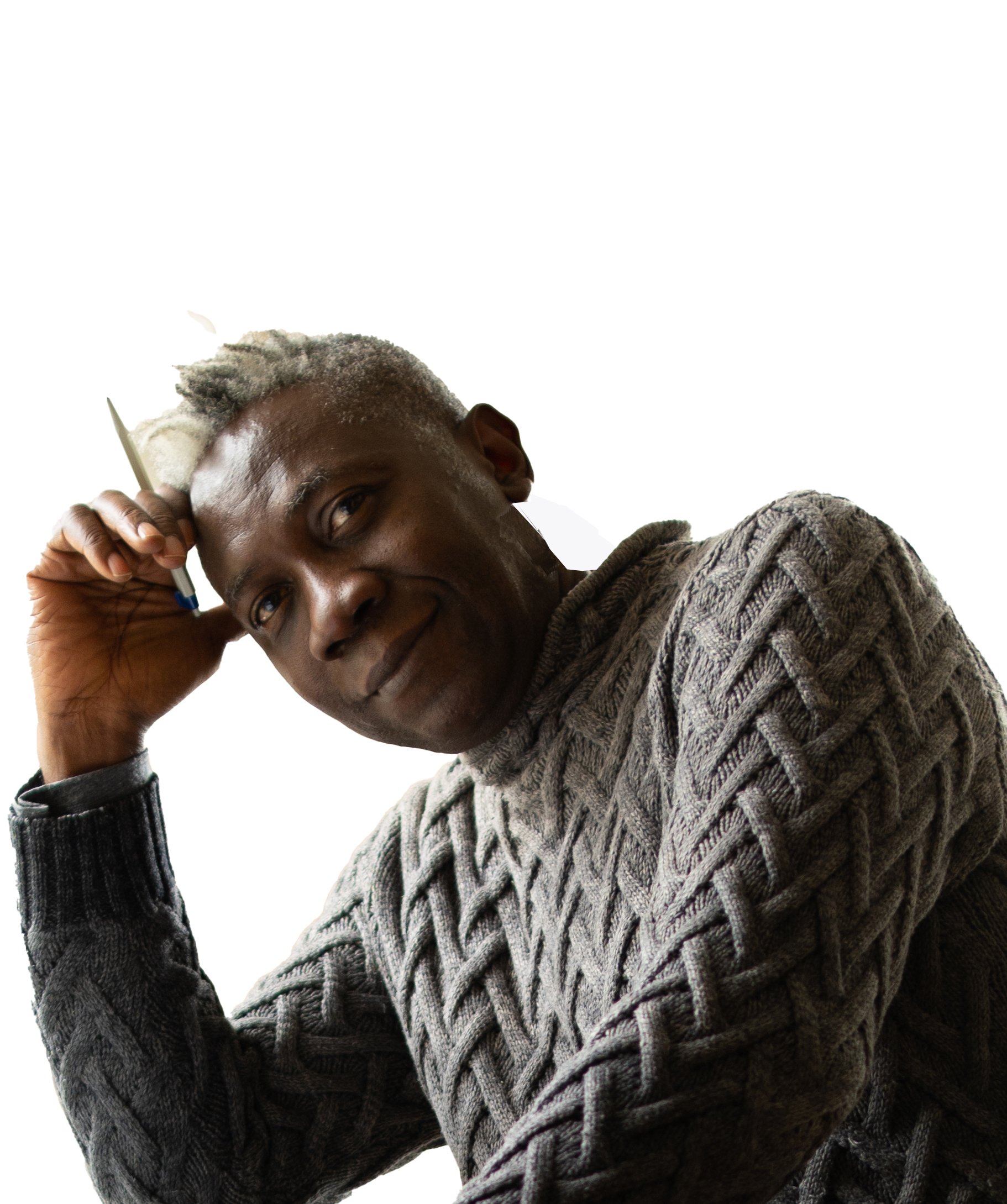
Meet Charles O. Job
I first came across Charles at Decorex Johannesburg 2025, where he was named Designer of the Year and delivered an exceptional keynote that left a deep impression on me. Beyond design as form and function, he spoke of imagination, memory, identity and more. Listening to him, I realised that his work is not just about objects — it is also about a journey.
A journey that began in childhood, in Lagos, with the resourcefulness of creating toys from whatever was at hand. That early playfulness, rooted in necessity, has blossomed in adulthood into a philosophy of innovation and design that values timelessness, adaptability for all, and the poetry of everyday life.
Designer, architect, and educator, Charles’s career spans from award-winning furniture to teaching the next generation of designers in Switzerland. Yet his work remains deeply personal: memories and life experiences become material for creation, transforming design into more than aesthetics or utility — a way of proposing beauty and simplicity that elevates daily life.
That makes his work unique, and this first conversation so meaningful for Moon Afrique. Enjoy!
““Design, for me, is still a form of play — it’s about using what’s around you and finding beauty in what’s simple.”
”
-Childhood & Lagos: The Art of Making from What You Have-
Prescillia: You grew up in Lagos, a place full of rhythm and inventiveness. Children often make their own games, toys, and tools from what’s around them. How did that shape your way of seeing and creating?
Charles: Lagos teaches you to improvise. We didn’t have many toys, so we made things. Not because someone told us to, but because it was fun — a way of playing, a way of imagining. Looking back, that was my first design school.
When you work with your own hands, you simplify things naturally. You become resourceful — and that resourcefulness, that ability to do a lot with very little, is something that’s stayed with me since childhood.
That mindset never left me. I’ve realised that even now, my process is very similar. If I have a project, I don’t start with a strict formula. Sometimes I write; sometimes I draw. But I always ask myself, what do I want to achieve, and how can I make it as simple as possible?
Design, for me, is still a form of play — it’s about using what’s around you and finding beauty in what’s simple. My inner child is always active (laughs).
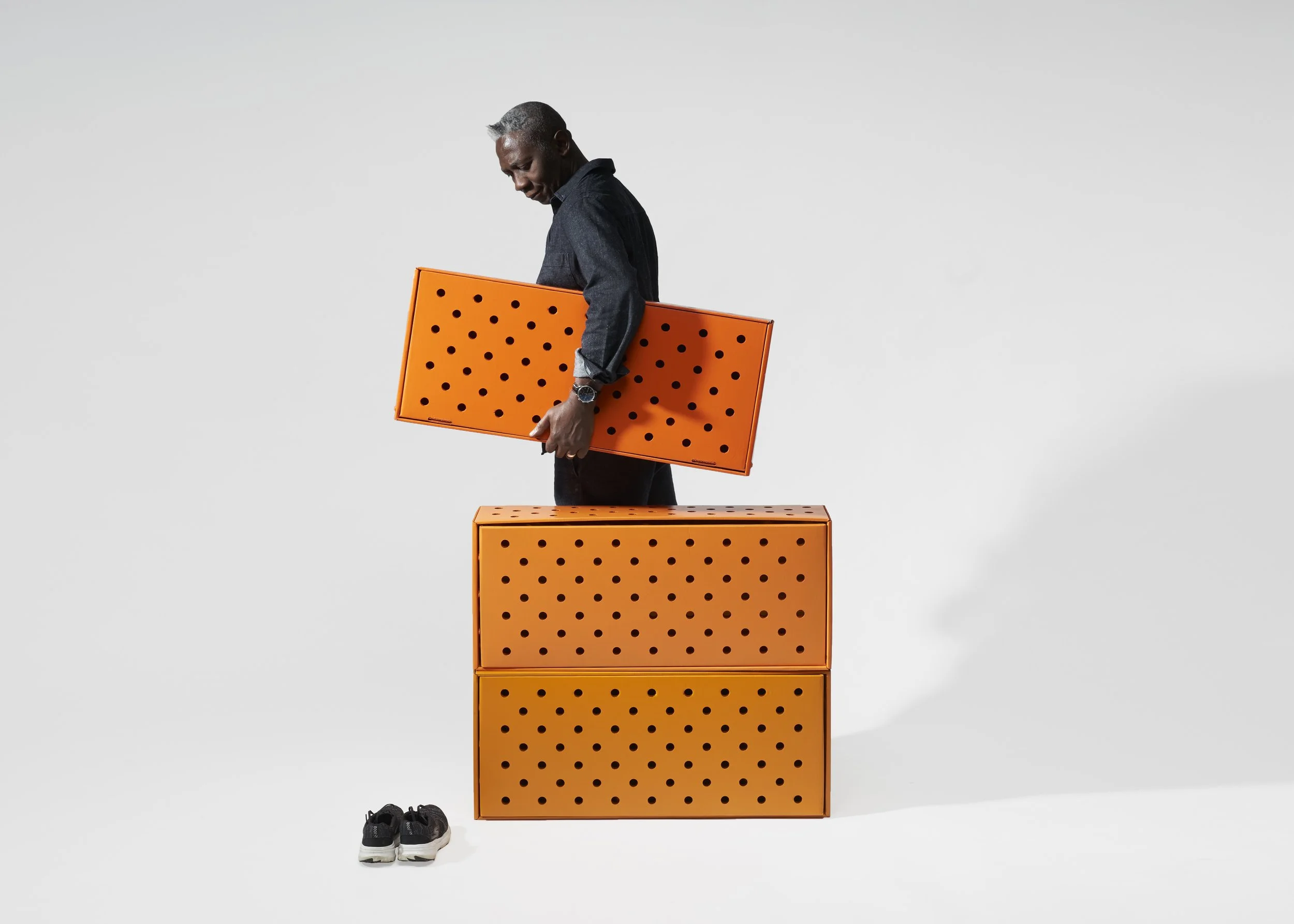
Aria shoe storage system made of cardboard.
-Becoming a Creator-
P: Did you always know you wanted to be a designer or an architect?
C: (laughs) Not at all. When I was thirteen, my father asked me, “What do you want to do?” and I said, “I have no idea.” So he sent me to one of those career centers in London, where they make you take an aptitude test. The result said I should be an agricultural assistant!
My father just looked at me and said, “You’re not going to be a farmer.” But he knew I liked to draw, so he said, “Why not try architecture?” I didn’t even know what that was. I went to an open day, saw people drawing buildings, and thought, “Okay, that’s interesting.”
That’s how it started. I didn’t dream of being an architect; I just wanted to be somebody who made things, creates, solves, and imagines.
Competitions became my playground. I loved having a brief and a deadline, a challenge. Even now, I still enter design competitions, not for the prize, but for the joy of invention.
-On Simplicity, Function, and Meaning-
P: Your work often feels simple yet profound; there’s a timelessness to it.
C: I believe objects should be functional and honest. I don’t make art furniture. I want my designs to be used, but also to bring a quiet elevation to daily life.
When I design, I ask myself: What can I bring to this that’s different — not just for the sake of being different, but to make it better? There are thousands of chairs in the world. If I’m going to make another one, it has to be meaningful. Simplicity is not about less but about clarity.
I always try to bring a bit of myself to every project — not in a self-centered way, but as a way of solving problems with honesty and curiosity.
-Assemblage: A chair about memory and connection-
P: One of my favourite pieces of yours is Assemblage. So simple, beautiful, the chair feels both very contemporary and deeply rooted in your story. Can you walk me through it?
C: Assemblage was born for an exhibition at the Moroccan Cultural Institute in Paris, curated by my friend Hicham Lahlou. The idea was to show African designers from different backgrounds.
For me, it was important to make something that carried an African spirit — but not through ornament or clichés. I asked myself, if I were back in Lagos, as a child, with what I had, how would I build a chair?
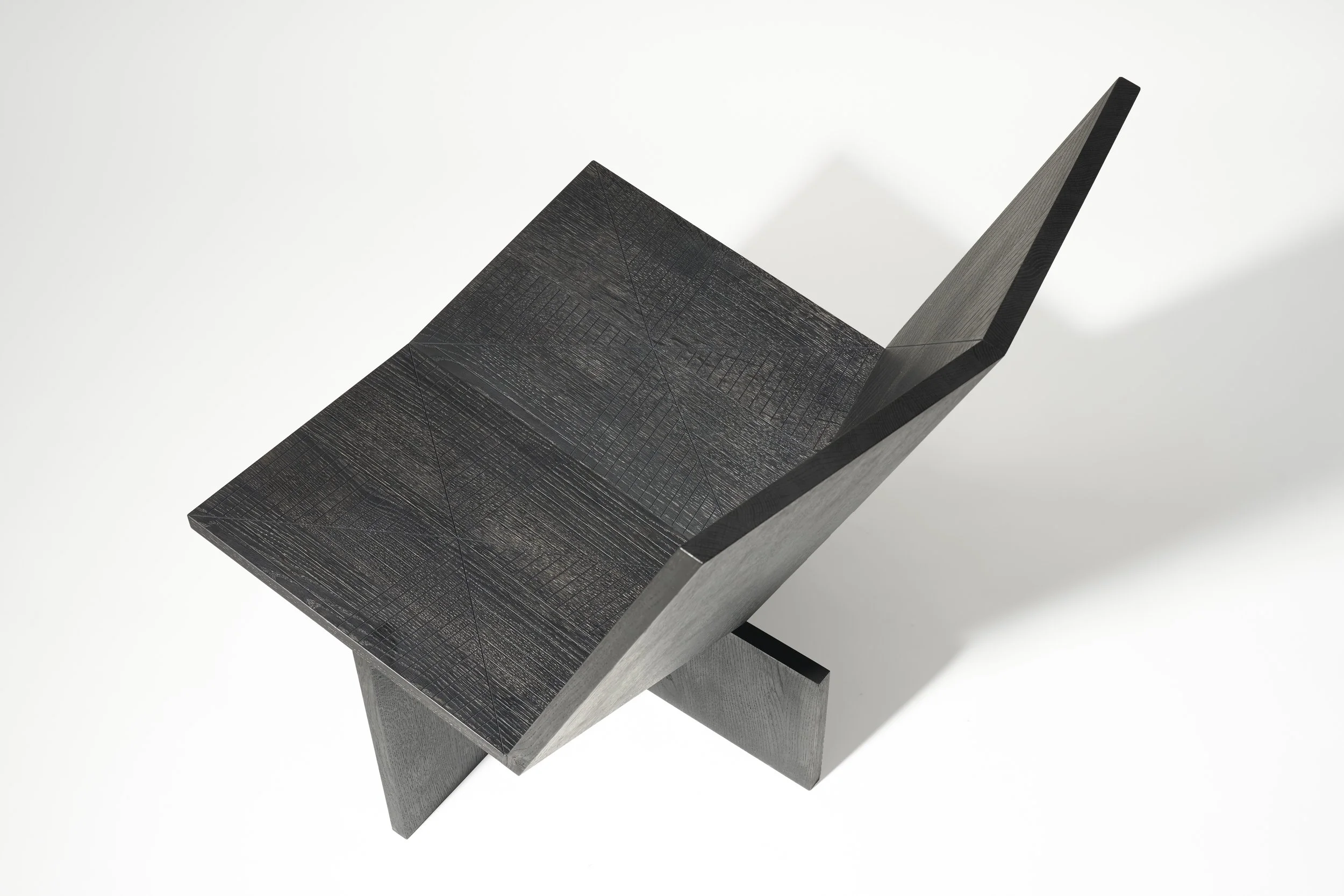
So it became about assembling simple parts: a seat, a back, a structure like building blocks. It’s easy to take apart and rebuild. It reflects how we used to make things as kids: not permanent, but full of life and movement.
It was first shown in Paris, then later in New York, and will soon join the collection of the Studio Museum in Harlem. That means a lot to me to see something that started as a personal reflection find its place in the world.
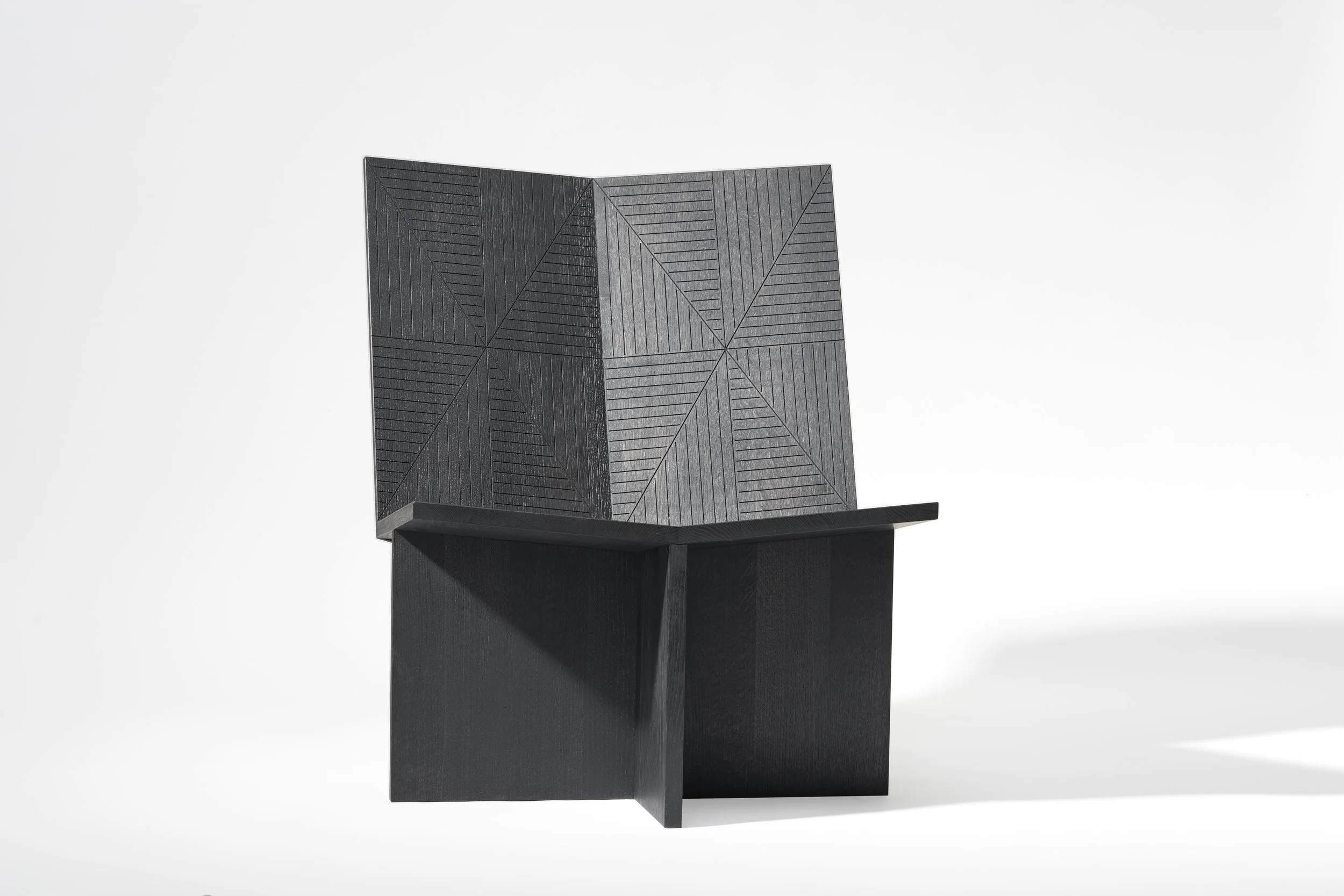
Assemblage chair, made of six wooden planks.
“ “Assemblage is about putting things together — materials, ideas, memories, people.””
-Identity & Duality-
P: I’ve been deeply moved by how your work speaks about identity.
As a French–Congolese woman, growing up, many institutions made us feel that we had to choose to let go of our roots, in order to be French. During your keynote, you mentioned that we don’t have to choose a side; we simply have to be. That really spoke to my inner child. How do you approach identity in your own creative process?
C: That’s a very beautiful question. You know, identity is not something I try to express; it just lives in what I do. I’ve lived in Lagos, London, Scotland, Paris, and now Switzerland. All these places have left their mark.
But I don’t design as an African or as a European. I design as myself, a mixture of all these influences. And maybe that’s what makes it universal.
I don’t see myself as just an African designer, though of course I am African. I see myself as someone formed by many experiences. What’s at the heart of it all is still that childhood belief: anyone can make something.
When I create, it’s less about representing where I come from and more about expressing how I see. The African part of me values resourcefulness.
That’s why I don’t feel the need to declare my identity in my work. It’s already there, inside it, naturally. It’s in the way I think, the way I simplify, the way I approach solving problems.
P: That’s exactly what I feel. It’s fluid, unforced.
C: Yes. You can’t separate your identity from your creativity. It’s all part of the same story.
-Teaching & Transmission-
P: You also teach in Switzerland. What would you like your students to take away from your classes?
C: I tell them: Anyone can be taught architecture, but design starts with how you see. Stay curious. Question things. Observe.
When I take my students to places like India, Egypt, or Istanbul, I want them to understand that design doesn’t come from perfection; it comes from adaptation. It’s important to step out of their comfort zone. Swiss students, for instance, live in a very ordered environment. I want them to see how people make things in different contexts, with different means. Curiosity is the beginning of all good design.
-The African Scene and Moving Forward-
P: You’ve been involved in many African initiatives, from Lagos Design Week to the AIDA Awards. How do you see the design scene evolving across the continent?
C: There’s so much happening, and what’s beautiful is that it’s happening in so many different ways. There’s a new confidence, a willingness to look inward instead of always outward.
I think it’s important that African designers don’t only look outward, but also look at each other to build something Pan-African. I’d love to see more collaboration across countries — designers in Lagos working with those in Johannesburg, Dakar, or Accra. When that starts to happen, the world will really feel Africa’s design voice.
For this, it was also important to me to meet producers and makers during my time in Johannesburg. I’m very interested in creating more things that are made in Africa, not only inspired by Africa. That’s an important distinction for me. It’s about building something that lives here, that is produced here, and that can travel into the world from here.
““We can learn from the past, but we must look toward the future.””
Charles’s keynote during Johannesburg Decorex 2025.
P: To close, if you had to describe yourself in three words?
C: Simple. Resourceful. Happy. (smiles)
P: A song you enjoy listening to while working, or that represents you well?
C: I listen to different songs when I work, but I can imagine Candela by Buena Vista Social Club for this article.
P: And what does home mean to you?
C: Home is where my wife, my kids, and my studio are. That’s it. (smiles) I travel a lot, but that’s the center of everything.
Prescillia: Thank you so much, Charles. This conversation truly felt like what your Vis-à-Vis bench represents: 2 people sitting and sharing thoughts!
Charles: Thank you, Prescillia. That’s exactly how I see it, too.
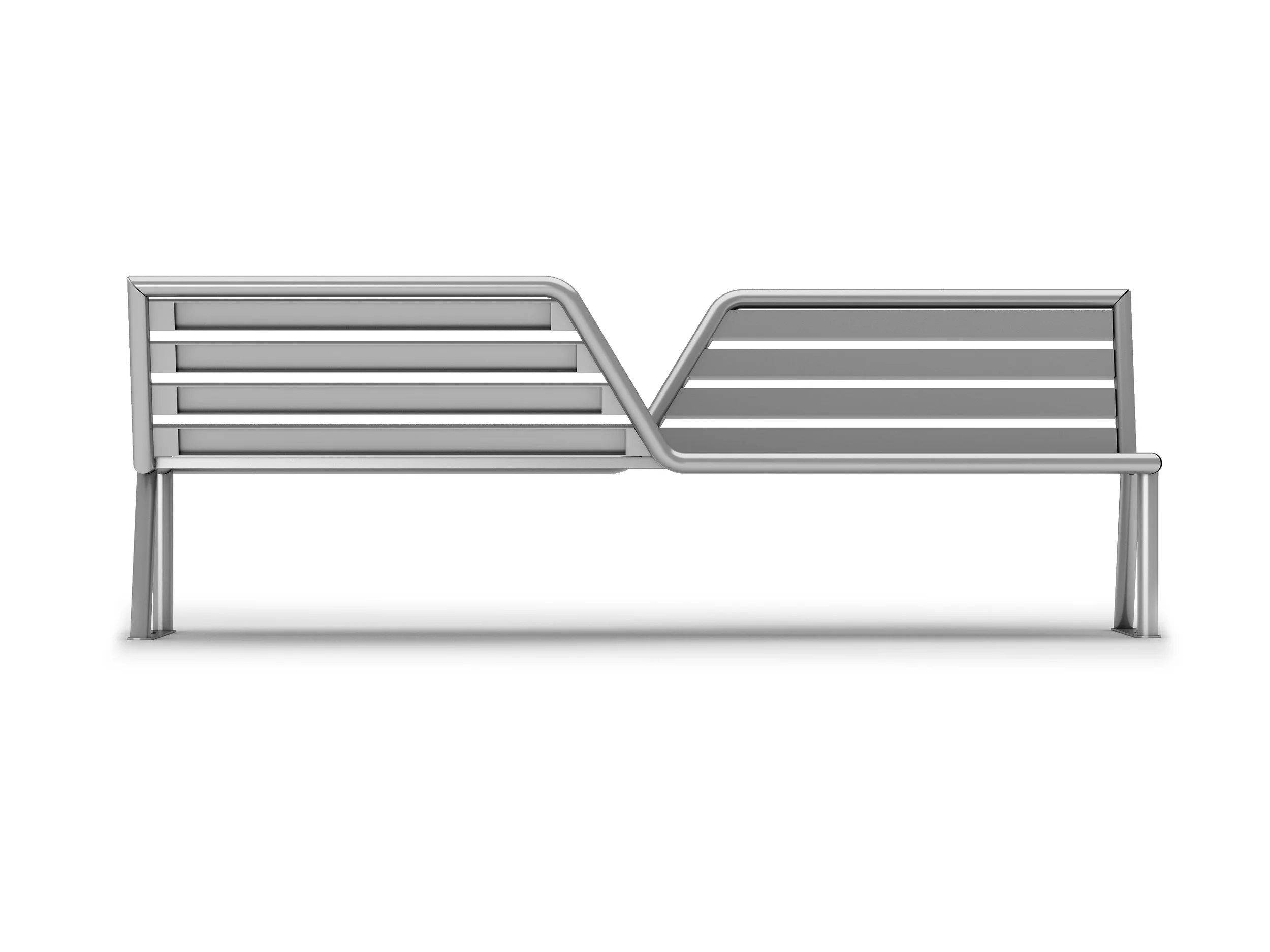
VIS-Á VIS, LILLE. The French City of Lille was elected City of Design 2020. To commemorate the event, the Vis-à-Vis bench was chosen from a selection of urban furniture to be placed in locations around the city. This is a new stainless steel version of the original.